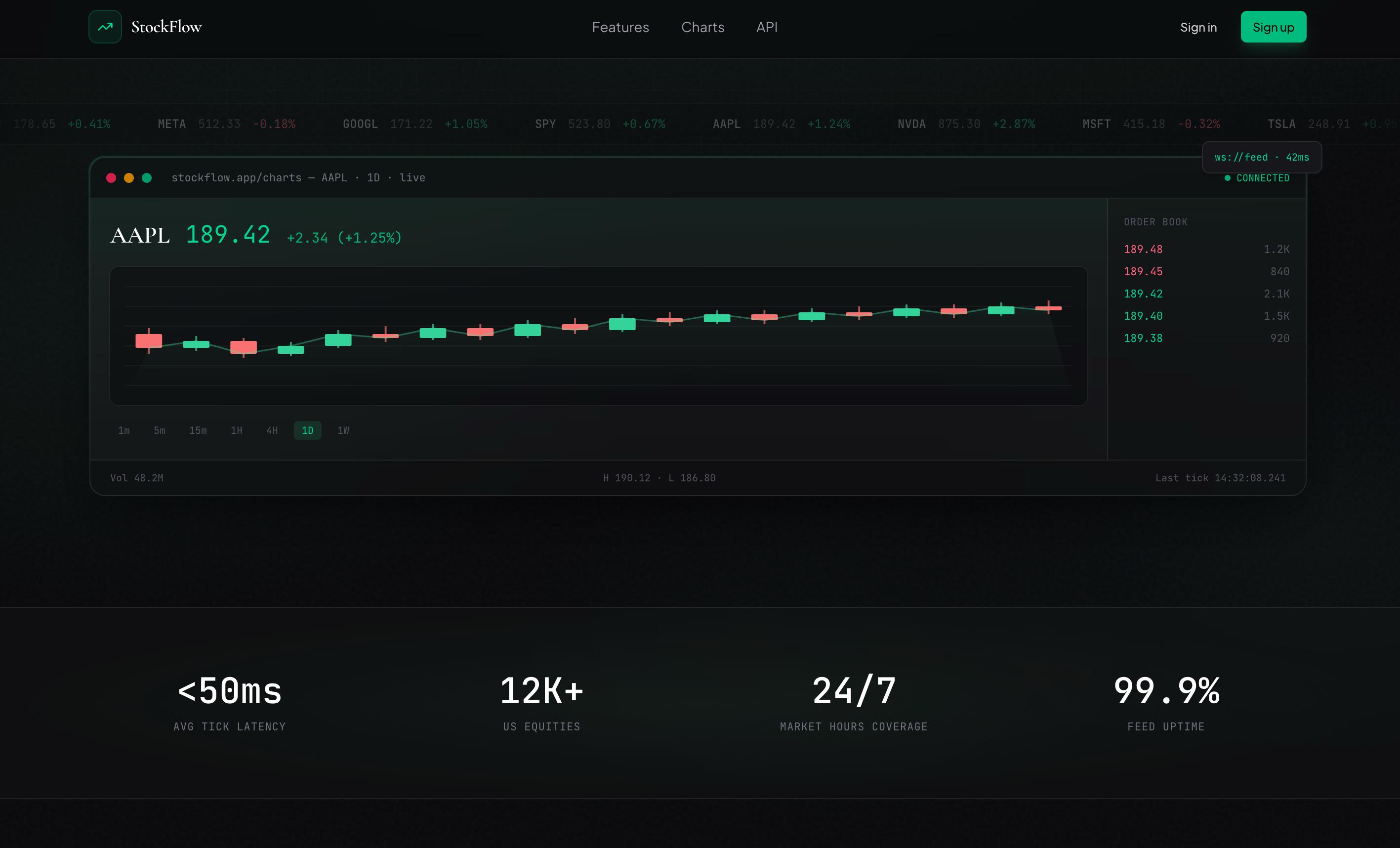
Overview
StockFlow is a cloud-native trading platform designed around event-driven architecture and real-time data processing.
The project focuses heavily on backend engineering problems involved in financial systems:
- High-throughput event ingestion
- Asynchronous processing
- Real-time updates
- Service isolation
- Horizontal scalability
- Fault tolerance
- Observability
The primary goal was to design the system around independent, scalable services rather than building a single monolithic backend.
Event-Driven Architecture
Apache Kafka acts as the backbone for communication between independent services.
Instead of tightly coupling services through synchronous HTTP calls for every operation, important domain events can be published to Kafka and consumed independently.
Conceptually:
Market Data → Kafka → Processing Services → Storage / Analytics → WebSocket Gateway → Clients
This architecture provides several advantages:
- Services can scale independently
- Producers and consumers are decoupled
- Consumers can process events asynchronously
- Processing workloads can be distributed
- Failures can be isolated between services
Backend Engineering with Go
Go was selected for backend services where predictable performance, concurrency, and efficient resource usage were important.
The backend was designed around:
- Concurrent request processing
- Explicit service boundaries
- Efficient network communication
- Structured error handling
- Stateless service design where possible
This also made the system well suited to containerized deployment and horizontal scaling.
Real-Time Data Delivery
Trading applications require information to reach clients quickly.
WebSockets provide a persistent connection between the backend and clients, allowing the server to push updates rather than requiring clients to continuously poll for changes.
This creates a pipeline where processed market events can be transformed into client-facing updates and pushed to connected dashboards.
Redis
Redis is used as a high-speed data layer for workloads where repeatedly accessing a slower persistent store would introduce unnecessary latency.
Caching also helps reduce repeated computation and database access for frequently requested information.
Kubernetes & Horizontal Scaling
Services are containerized using Docker and deployed using Kubernetes.
The architecture allows individual services to scale based on their workload rather than scaling the entire application together.
For example, a high-volume market-data consumer can be scaled independently from an API service or WebSocket gateway.
This is one of the major advantages of decomposing a system into independently deployable services.
Observability
Distributed systems become significantly harder to debug as the number of services increases.
StockFlow incorporates an observability stack involving:
- Prometheus for metrics
- Grafana for visualization
- OpenTelemetry for distributed tracing
The goal is to make system behavior observable across service boundaries rather than relying only on application logs.
Frontend Engineering
The frontend provides real-time trading dashboards designed around rapidly changing data.
The frontend architecture needs to handle:
- Persistent WebSocket connections
- Frequent state updates
- Efficient rendering
- Large volumes of changing data
- Clear visualization of market information
The challenge is balancing real-time updates with rendering efficiency so that frequent backend events do not unnecessarily re-render the entire interface.
System Design Lessons
StockFlow was primarily an exercise in understanding how backend systems behave under distributed workloads.
The most important lessons were:
- Use asynchronous processing where synchronous communication becomes a bottleneck.
- Decouple services around domain events.
- Scale workloads independently.
- Treat observability as part of the architecture.
- Use caching strategically rather than indiscriminately.
- Design real-time systems around event flow rather than request-response alone.
This project significantly strengthened my understanding of distributed systems, backend architecture, concurrency, and production infrastructure.